Symbol of Tri-National Unity Takes Center Stage
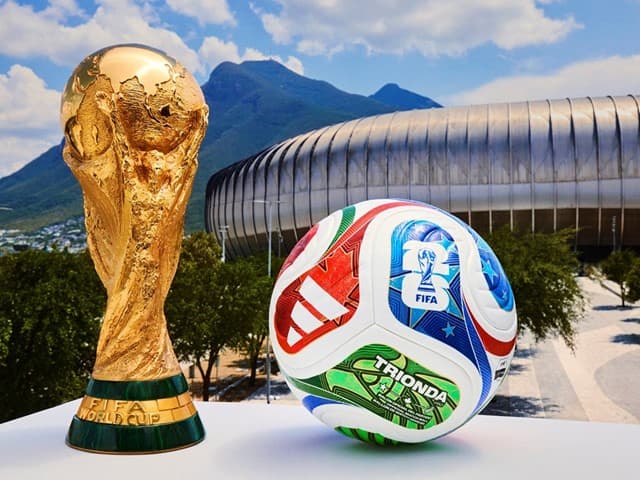
As the countdown to the 2026 FIFA World Cup begins, Adidas has unveiled the tournament's official match ball, the Trionda—a striking sphere that represents more than just cutting-edge sports technology. It's a celebration of unity among three North American nations preparing to co-host football's greatest spectacle.
Released on October 2, 2025, the Trionda marks the 15th consecutive World Cup ball designed by Adidas, continuing a partnership with FIFA that dates back to 1970. But this ball is unique in World Cup history: it is the first to honor three host nations simultaneously.
The Name and Design Philosophy
The name "Trionda" cleverly combines Spanish words that capture the tournament's essence: "tri" meaning three, and "onda" meaning wave. This linguistic fusion acknowledges the unprecedented collaboration between the United States, Canada, and Mexico while evoking the cultural phenomenon of stadium waves that have become synonymous with American sports culture.
The ball's visual design is equally thoughtful. Against a predominantly white background, three colors dominate the swirling geometric patterns: red for Canada, blue for the United States, and green for Mexico. Each color section features symbolic national iconography: Canadian maple leaves adorn the red panels, American stars punctuate the blue sections, and a stylized Aztec eagle represents Mexico's rich heritage on the green swathes. Gold embellishments throughout the design pay homage to the World Cup trophy itself, adding a touch of championship prestige to every panel.
Revolutionary Four-Panel Construction
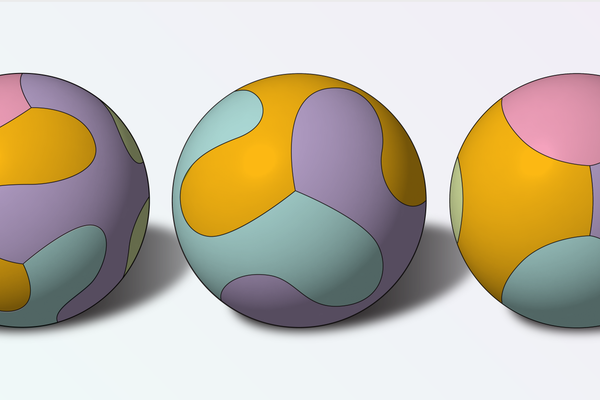
From a technical standpoint, the Trionda represents a bold departure from recent World Cup balls. Its four-panel construction is the smallest number of panels ever used in a World Cup match ball, making it a structural outlier in tournament history.
This design choice is particularly intriguing because it echoes the geometry of the 2014 Brazuca, which also broke from tradition with just six panels. However, the Trionda takes this minimalism further, basing its structure on a tetrahedron: a four-sided platonic solid that, at first glance, seems impossibly unsuited to creating a sphere.
The secret lies in the panel shapes. While each panel has three points like a triangle, the edges are curved rather than straight, allowing them to fit together seamlessly and create a more rounded exterior. This approach to transforming a geometric solid into a spherical ball through edge manipulation was pioneered with the Brazuca's cube-based design, and the Trionda pushes this concept even further.
The four-panel construction incorporates intentionally deep seams—a critical design feature that creates optimal in-flight stability by ensuring sufficient and evenly distributed drag as the ball travels through the air. This addresses one of the most significant challenges in modern ball design: maintaining predictable flight characteristics at various speeds and spin rates.
Learning from Past Controversies
The evolution toward the Trionda's design reflects lessons learned from previous World Cup balls, particularly the infamous 2010 Jabulani. That eight-paneled ball became one of the most controversial in World Cup history, with players complaining that it behaved unpredictably—swerving erratically and decelerating suddenly mid-flight.
Scientific analysis revealed the Jabulani's problems stemmed from being too smooth and too perfectly spherical. The ball had a higher "critical speed"—the velocity at which drag suddenly decreases—which caused it to slow abruptly during flight. Additionally, its relative lack of symmetry compared to traditional designs meant drag affected different points on the ball unevenly, creating a "knuckleball effect" that made its trajectory difficult to predict.
The Brazuca successfully addressed these issues with its six-panel design, deeper seams, and improved surface texture. Players generally praised the Brazuca, and its positive reception helped validate Adidas's approach to fewer panels combined with better aerodynamic features.
The 2018 Telstar 18 and 2022 Al Rihla continued this evolution. The Telstar 18 maintained six panels but arranged them differently to create a visual callback to the iconic 32-panel ball from 1970. The Al Rihla increased to 20 panels and introduced water-based inks and glues for sustainability, while also becoming the fastest World Cup ball in flight.
The Trionda appears designed with all these lessons in mind. While its tetrahedron-based structure creates only 12 rotational symmetries compared to the classic Telstar's 60, it compensates with surface features designed to improve aerodynamic performance. The ball includes visible divots and grooves in its surface—features that help manage drag more effectively and avoid the Jabulani's pitfalls.
Cutting-Edge Connected Ball Technology

Perhaps the Trionda's most significant innovation is its updated Connected Ball Technology, developed in partnership with Kinexon. The ball features a 500Hz inertial measurement unit (IMU) motion sensor that tracks every aspect of the ball's movement with unprecedented precision.
What makes this iteration special is the sensor's placement. Unlike the Al Rihla, which suspended the sensor in the center of the ball, the Trionda mounts the chip within one of its four panels. This side-mounted design required careful engineering to maintain balance—counterweights are strategically placed in the other three panels to ensure the ball's flight characteristics remain consistent.

The sensor sends data 500 times per second to anchor points around the stadium, which then relay information to the Video Assistant Referee (VAR) system in real time. Combined with player position data and artificial intelligence, this technology enables faster and more accurate offside decisions. The system can also identify individual touches on the ball, helping officials resolve controversial situations involving potential handballs or fouls.
This represents a significant upgrade from the Al Rihla's connected technology, which was the first to feature such sensors in a World Cup ball. The AI-enhanced capabilities of the Trionda promise to reduce the time officials spend reviewing incidents, maintaining the game's flow while improving decision accuracy.
Performance Features
Beyond its high-tech sensors, the Trionda includes several performance-enhancing features designed for elite-level play. The ball features embossed icons throughout its surface—barely visible from a distance but tactile up close. These raised elements provide enhanced grip when striking or dribbling, particularly valuable in wet or humid conditions that players might encounter across the diverse climates of North American host cities.
The ball's thermally bonded, seamless surface construction ensures a more predictable trajectory, better touch, and minimal water uptake. Made from high-end materials including a polyurethane outer layer, recycled polyester backing, and a butyl bladder, the official match ball is FIFA Quality Pro Approved for professional play.

Adidas conducted extensive testing of the Trionda across various weather conditions, altitudes, and stadiums to ensure consistent performance throughout the tournament. This thorough evaluation process reflects lessons learned from past World Cups, where balls sometimes performed differently than expected in match conditions.
Comparing the Trionda to Its Predecessors
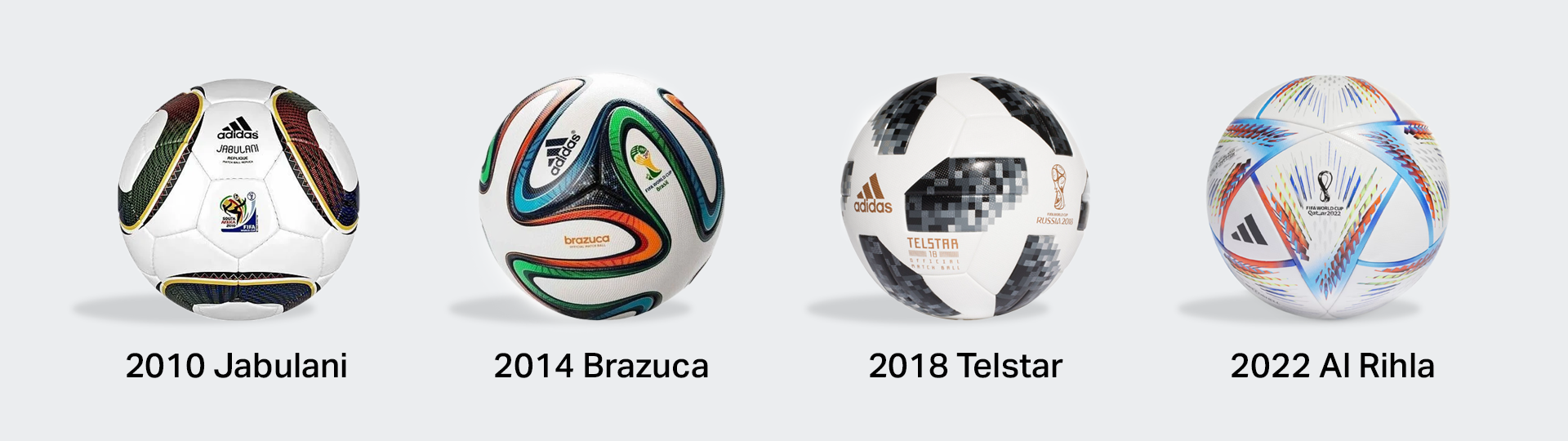
vs. Al Rihla (2022): The most recent World Cup ball featured 20 panels—16 more than the Trionda—and took a more traditional approach to panel distribution. The Trionda's four-panel design is dramatically simpler, potentially offering more consistent flight characteristics due to fewer seams and panel junctions. The side-mounted sensor in the Trionda represents an evolution from the Al Rihla's center-mounted system.
vs. Telstar 18 (2018) and Brazuca (2014): Both balls featured six panels in thermally bonded construction. The Trionda's reduction to four panels makes it even more streamlined. The Brazuca, particularly, shares the Trionda's philosophy of using curved panel edges to create spherical shapes from geometric solids. The Trionda can be seen as the spiritual successor to the well-received Brazuca, taking its design principles to a new extreme.
vs. Jabulani (2010): This comparison is especially relevant given the Trionda's tetrahedron-based design, which makes it similarly aspire to near-perfect sphericity. However, the Trionda appears to have learned from the Jabulani's mistakes. The intentionally deep seams and surface textures on the Trionda should provide more consistent drag characteristics, avoiding the unpredictable behavior that plagued the eight-panel Jabulani.
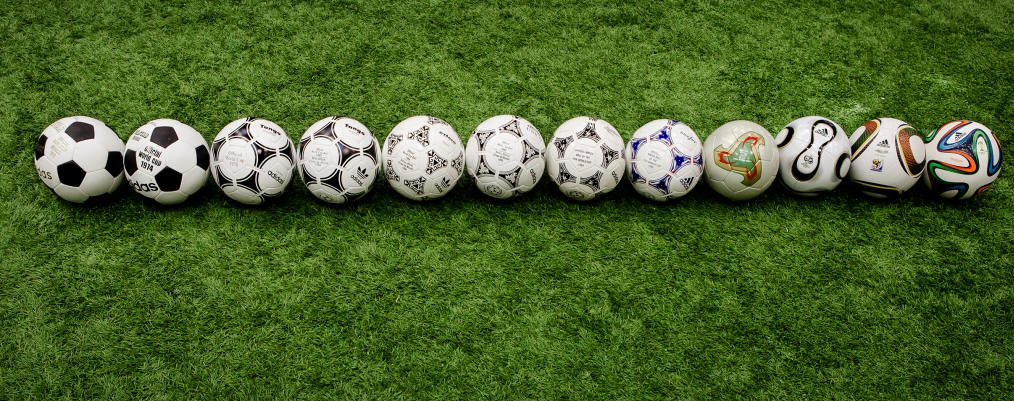
Historical Context: Before the modern era of thermally bonded panels, World Cup balls typically featured 32 panels hand-stitched together—the iconic pattern introduced with the 1970 Telstar. The steady reduction in panel count over recent tournaments reflects advances in manufacturing technology and aerodynamic understanding. The Trionda represents the culmination of this trend, proving that fewer panels, when properly designed, can deliver superior performance.
Cultural Impact and Availability
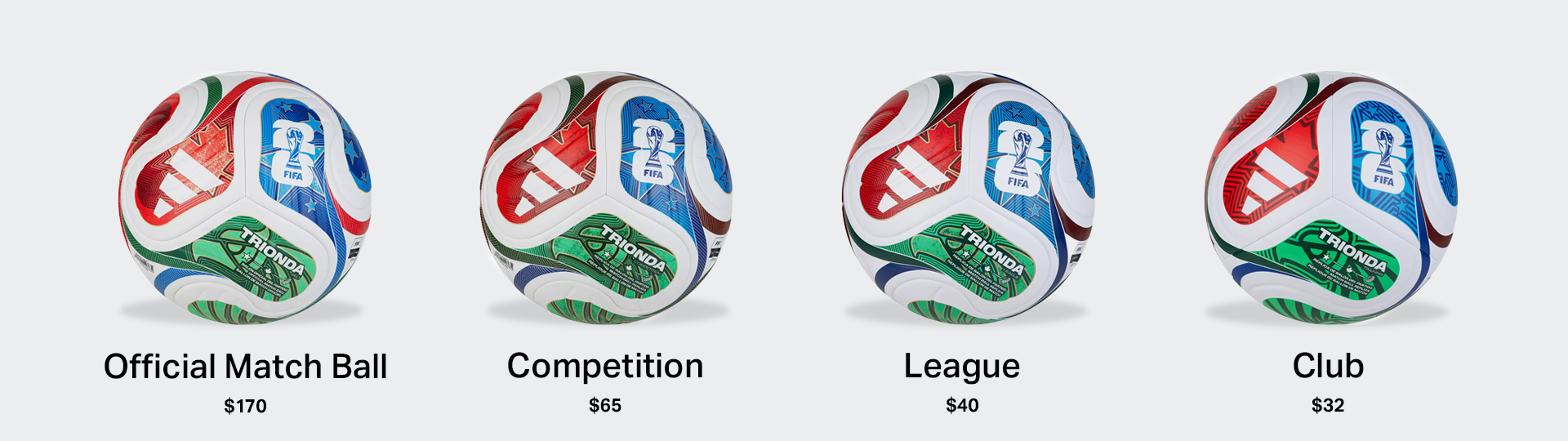
The Trionda is priced at $170 (€160) for the official match ball, consistent with recent World Cup balls. Adidas has also released several takedown versions at lower price points: the Competition model at $65, the League edition at $45, and the entry-level Club version at $32. Notably, for the first time with an Adidas takedown ball, even the Competition version features grooves—a feature previously exclusive to official match balls.
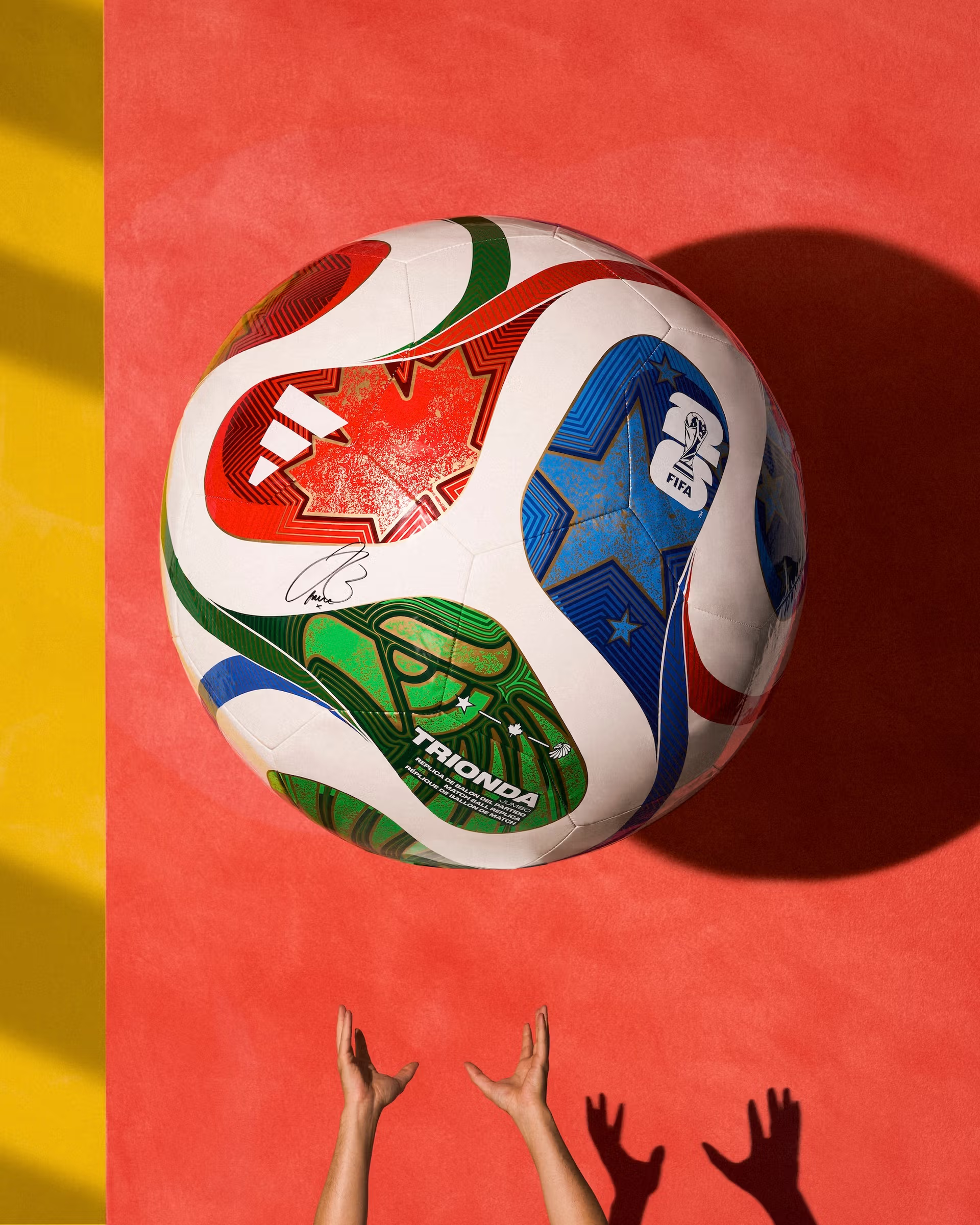
Beyond the pitch, the Trionda is poised to become a cultural icon. World Cup balls consistently transcend sport, appearing in street art, fashion, and youth academies worldwide. The Trionda's unique status as the first tri-national World Cup ball gives it special significance for collectors and fans.
The ball made its spectacular debut with a holographic presentation against the New York skyline and will be used in upcoming World Cup qualifying matches before taking center stage at all 104 matches of the 2026 tournament, which kicks off in Mexico City on June 11, 2026, and concludes with the final at MetLife Stadium in New Jersey on July 19.
The Bottom Line
The Trionda represents Adidas's most ambitious World Cup ball design yet—a four-paneled sphere that honors three nations while incorporating cutting-edge technology and lessons learned from two decades of innovation. Its tetrahedron-based geometry is a calculated risk that draws inspiration from both the beloved Brazuca and the controversial Jabulani, while its side-mounted sensor system and AI-enhanced capabilities push match officiating into a new era.
Whether the Trionda will be remembered as a triumph of design or face criticism like some of its predecessors remains to be seen. But one thing is certain: when players take the field next summer for the largest World Cup in history, they'll be playing with a ball that represents the cutting edge of sports technology and the spirit of international unity that defines the world's game.